
Chamberlain Garage Door Repair in Paterson: A Homeowner’s Guide
Chamberlain is the most installed garage door opener brand in Paterson, which also makes it the most frequently misdiagnosed. A blinking light or a door that refuses to close gets labeled a dead logic board on a dozen forums, and the homeowner ends up pricing a whole new unit when the fix was a two-minute sensor adjustment. Most Chamberlain failures we see are single-component problems. This guide walks through the ones that actually come up in Paterson homes, what the blink codes tell you, and when repair stops being worth it. If you’d rather not sort through it yourself, call (844) 902-2470 for a free estimate.
What does Chamberlain error code 4-6 actually mean?
Error code 4-6 – the door won’t close and the light blinks four times – means the safety sensors aren’t seeing each other. It does not mean the logic board has failed, even though that’s the first diagnosis you’ll find online. In our experience, the large majority of these are alignment problems, not electronics. Before you price a new opener, check these in order:
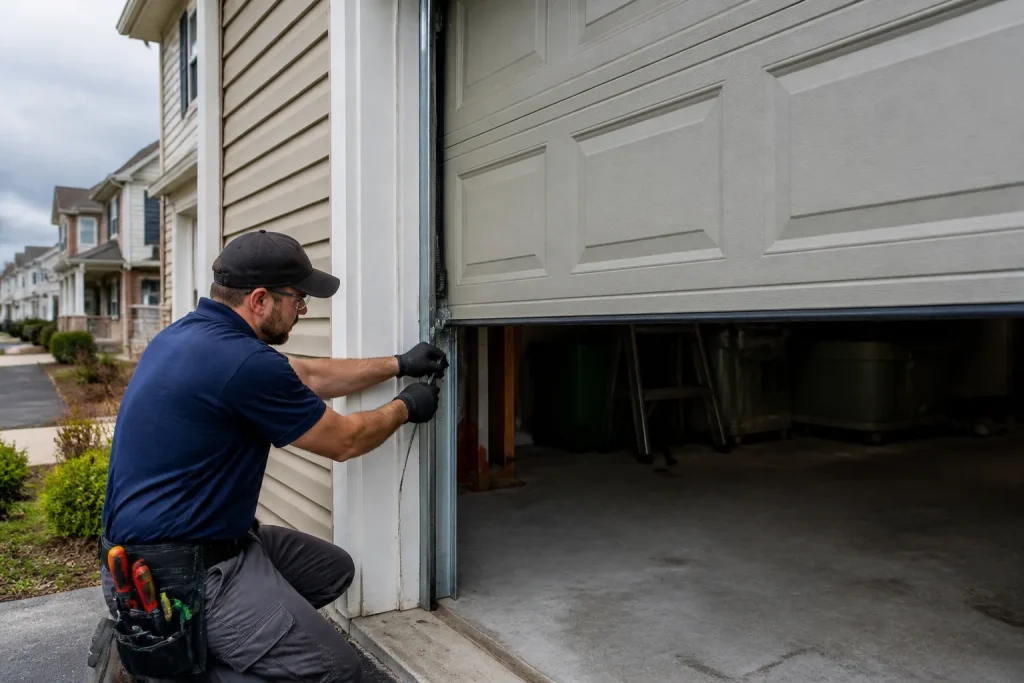
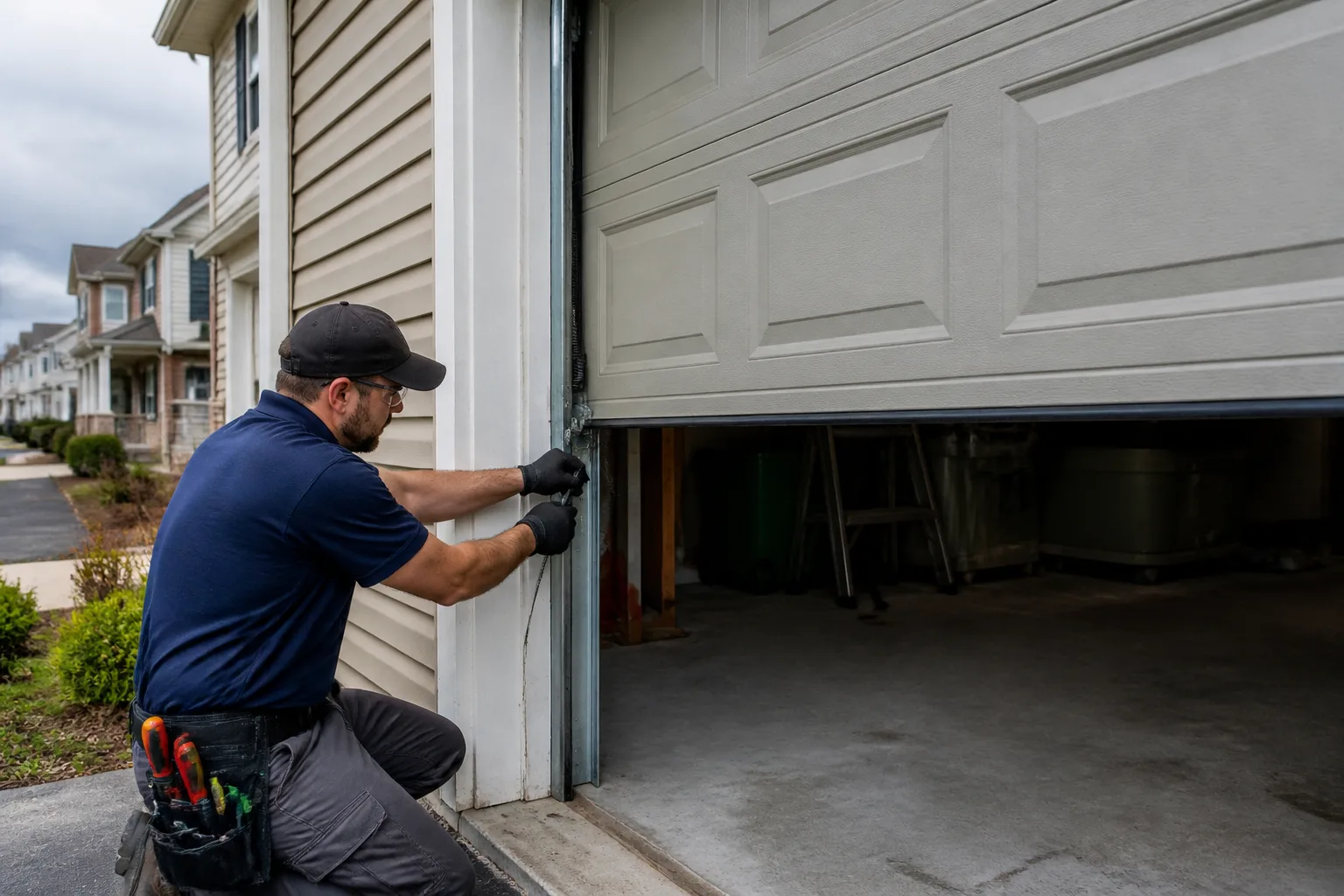
- Sensor alignment. The two sensors at the bottom of the tracks must face each other squarely. A bumped track, a loose bracket, or a slightly bent mount is enough to break the beam. Look for a solid LED on both units, not a blinking one.
- Sunlight. Direct sun into the receiving sensor can blind it on west-facing doors. Shade it with your hand and see if the door closes.
- Obstruction. Spiderwebs, leaves, and in Paterson’s damp months, a film of grime on the lens will do it.
- Wiring. The low-voltage wire running along the track gets nicked, pinched, or chewed. A visual check along its full length catches most of these.
Only after those four are ruled out does the logic board become a suspect. If a sensor swap and a wire check don’t clear the code, then it’s time for a technician to meter the circuit. That’s the point where brand-specific diagnostics matter, and it’s why we treat garage door opener repair as its own service rather than a footnote under general repair.
Why do Chamberlain openers fail differently in Paterson’s climate?
Paterson’s weather does two specific things to a Chamberlain opener, and each has its own signature. Humidity is the first. The Greater Paterson area sits in a humid continental band with muggy summers and damp springs, and that moisture works its way into garages that aren’t climate-controlled. The logic board and its connector pins are the vulnerable point – corrosion builds slowly, and the unit starts behaving erratically before it fails outright. The tell is intermittent ghost behavior: the door opens on its own, the remotes drop out for a day and come back, or the wall console stops responding while the safety reverse still works.
Cold is the second. New Jersey winters harden the grease in the drive assembly and shrink the tolerances in the gear case. A worn drive gear that runs quietly in July will strip and grind in January, and you’ll hear it before it fails. That sound – a motor running with the chain or belt not moving – points at the gear and sprocket assembly, not the motor itself.
Here’s how the blink codes line up:
- Four blinks, door won’t close: safety sensor obstruction or misalignment (code 4-6).
- Five blinks: the opener is sensing too much resistance on the travel path. Look for a binding door, a worn roller, or a track that’s out of line before blaming the opener.
- Ten blinks: the safety sensors are wired or connected incorrectly.
- Rapid blinking with no travel: the motor is stalling, which on an older Chamberlain usually traces to the gear assembly or the start capacitor.
If your door won’t move at all, the problem may be mechanical rather than electronic, and our garage door repair team handles both sides. High-tension springs and cables are not a homeowner job, so leave that side to a trained technician.
Why won’t my Chamberlain connect to myQ?
Nine times out of ten, a Chamberlain opener that “won’t connect” is sitting on the wrong Wi-Fi band. Chamberlain’s myQ system, like the LiftMaster units that share its technology platform, runs on 2.4GHz. A 5GHz-only network, or a router that hands out both bands under one name, will fail the pairing every time. Before you call anyone, confirm these:
- Your phone is on the 2.4GHz band when you run setup. Split your bands temporarily if your router combines them.
- The opener is within range. Garage walls, metal doors, and foil-faced insulation all cut signal. If the opener is on the far wall of a detached garage, range is the likely culprit.
- Your router’s security settings are compatible. WPA2 works reliably; some older WEP setups do not.
- The opener’s Wi-Fi radio is actually awake. A power cycle at the breaker resets it. If the unit never broadcasts a setup signal after a reset, that’s a hardware issue, not a network one.
If you’ve cleared all four and myQ still won’t pair, the Wi-Fi module or logic board is the suspect. That’s a component swap, not a new opener. We work on the myQ ecosystem regularly, and we know which part of the chain fails first.
Which Chamberlain parts need OEM, and which don’t?
This is where a lot of money gets wasted in both directions. Some Chamberlain components are proprietary enough that aftermarket parts cause trouble; others have equivalents that work perfectly and cost far less. Here’s the hierarchy we use:
- Logic boards and wall consoles: OEM only. The firmware and the communication protocol are brand-specific, and a mismatch causes erratic behavior that looks like a new fault.
- Safety sensors and their brackets: OEM for Chamberlain and its LiftMaster siblings, since alignment tolerances are tight and an ill-fitting bracket puts you right back at error 4-6.
- Drive gears and sprocket assemblies: good aftermarket equivalents exist and perform reliably. This is the most common wear part on an older chain-drive unit, and it’s where the smart money goes.
- Trolleys and belts: aftermarket is fine if the spec matches the door weight and the track length.
- Remotes: aftermarket remotes work, but check compatibility against your opener’s model year. Older remotes often need a receiver upgrade to pair with a newer unit.
One warning worth flagging: a generalist who swaps a gear without rechecking the force adjustment calibration afterward is setting up a callback. Chamberlain requires the force limits to be reset after any mechanical repair so the motor doesn’t strain against a door it thinks is heavier than it is. That calibration step is why brand-matched diagnostics matter. If you’re weighing repair against replacement across brands, we handle Raynor, Genie, and LiftMaster systems with the same discipline.
Is your Chamberlain worth repairing?
Drive type and model year decide this more than anything else. Use these thresholds as a starting point, not a hard rule – the condition of the door and the rest of the system matters too.
- Belt drive: quietest and longest-lasting of the three. A belt-drive Chamberlain under about fifteen years old is almost always worth repairing. Over that, weigh the repair against the lifetime of the components around it.
- Chain drive: the workhorse, and the most common in Paterson homes. Expect gear and sprocket wear in the ten-to-fifteen-year window. A gear replacement on a chain-drive unit in that range is a fraction of a new opener and clearly worth it.
- Screw drive: fewer moving parts and less to fail, but repair parts are harder to source. A screw-drive unit over fifteen years old with a failed motor is usually better replaced than fixed.
The general principle: if a single component has failed and the motor, track, and door are sound, repair it. If two or more major components are at end of life, or the unit predates current safety features, replacement makes more sense – and the same company that repairs your current opener can install the new one when that time comes.
When to call a pro
Sensor alignment, Wi-Fi troubleshooting, and remote pairing are all fair game for a careful homeowner. Stop and call when the work involves the torsion spring, the cables, or a live electrical panel. Those carry real injury risk and belong to a trained technician. If the door is binding, the opener is grinding, or you’ve cleared a code and it keeps returning, that’s our cue.
Still deciding between repair and replacement? Our guide to Paterson garage door service covers the full picture. Whether your door won’t open, your opener is grinding, or it’s time for a full replacement, one call covers all of it.
The Bottom Line
Most Chamberlain failures in Paterson are one part, not one unit. Error 4-6 is nearly always a sensor problem, myQ pairing problems are nearly always a 2.4GHz issue, and cold-weather grinding is nearly always the drive gear. Check the cheap fixes first, confirm whether your model is worth repairing by drive type and age, and let a technician handle anything involving the springs, cables, or wiring. Brand-specific diagnostics, not guesswork, is what keeps a repair a repair.
If you’re in Paterson and need help, Lancaster Garage Door Service offers free estimates across Chamberlain, LiftMaster, Genie, Raynor, and the rest of the eight brands we’re trained on. Lancaster Garage Door Service covers repair, opener repair, and full installation in one place. Call (844) 902-2470 for a free estimate. We answer 24/7. Fast dispatch from 7am to 7pm, Sunday through Friday.
Frequently Asked Questions
The number of blinks is the diagnostic code. Four blinks usually means the safety sensors aren’t aligned or are obstructed, five means the opener is sensing too much resistance on the door, and ten points to a sensor wiring problem. Count the blinks before you do anything else – the code tells a technician exactly where to start.
It’s technically a plug-and-play swap, but it’s not the right first move. If the trouble is error 4-6, a sensor or wiring fault will produce the same symptoms and a new board won’t fix it. Have the sensor and force calibration checked first. If the board is genuinely at fault, an OEM replacement of the matching model is the correct path.
Match the drive type to its age. A belt-drive unit under fifteen years old with a single failed component is worth repairing. A chain-drive unit in the ten-to-fifteen-year range with gear wear is worth repairing. A screw-drive unit over fifteen years old with a dead motor is usually better replaced. Two or more major failures means replacement.
Humidity and cold hit different components. Damp air corrodes the logic board and its connector pins, causing intermittent ghost behavior, while freezing temperatures harden the drive grease and expose worn gears. If your opener acts up in a particular season, that pattern tells a technician which part to inspect first.
Written by the team at Lancaster Garage Door Service.
Need Garage Door Help?
Call Lancaster Garage Door Service - licensed & insured, here with fast help in Paterson.
(844) 902-2470